
Database map
bash
repomap db                          # schema from the repository
repomap db --url-env DATABASE_URL   # live database, read-only
repomap db users                    # one table in detail
repomap db --serve                  # graph UI (or --out db.html)
repomap db --json                   # machine-readable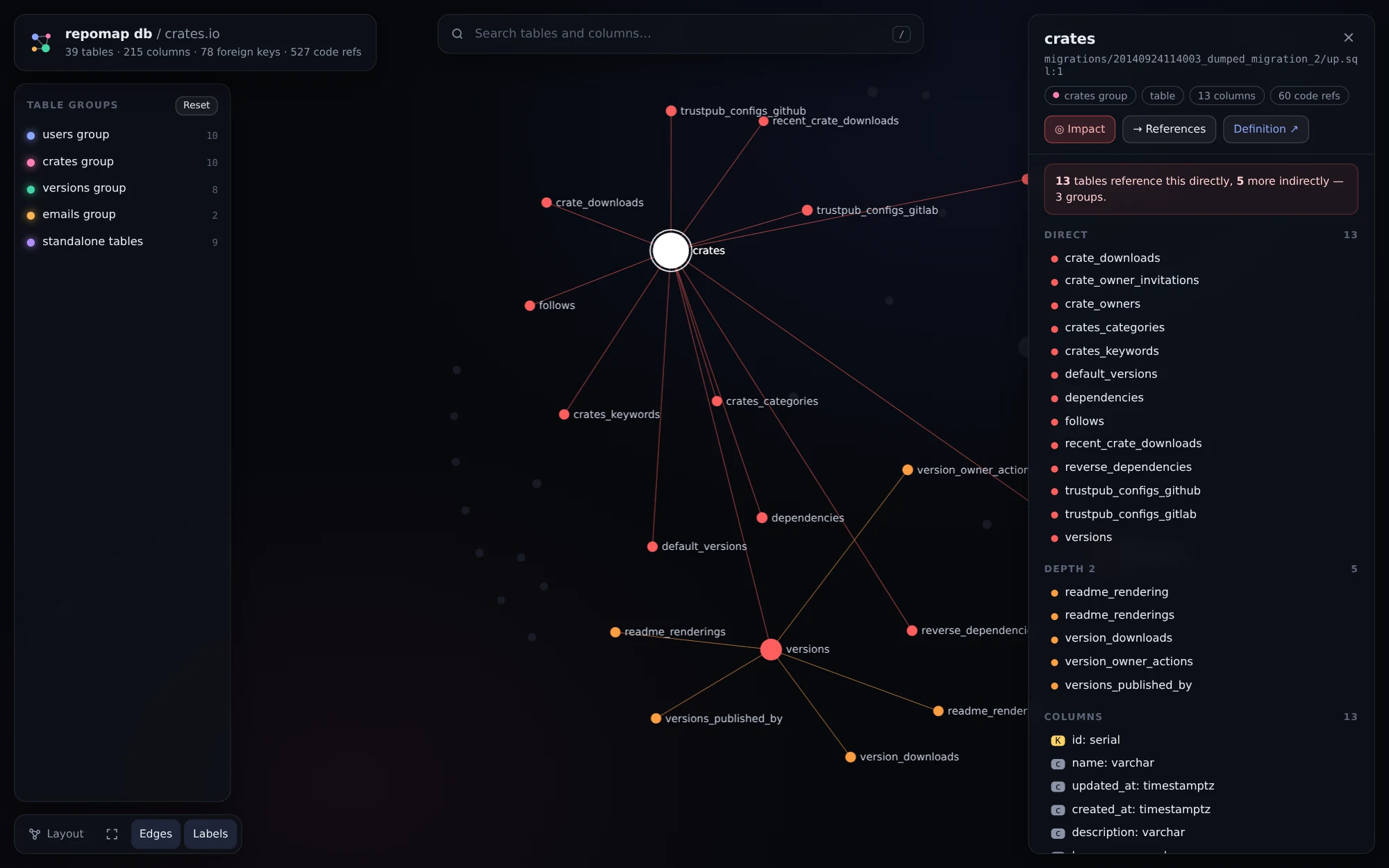
Sources
| Source | What is read |
|---|---|
| SQL migrations | every *.sql file in path order (timestamps sort): CREATE TABLE, ALTER TABLE … ADD/DROP/RENAME/ALTER COLUMN, ADD CONSTRAINT … FOREIGN KEY, CREATE [UNIQUE] INDEX, DROP TABLE. down.sql, rollback, seed and fixture files are skipped. |
| Prisma | *.prisma: models, @@map/@map, @id, @unique, @relation(fields, references), @@index/@@unique/@@id |
| Drizzle | pgTable / mysqlTable / sqliteTable: columns, .primaryKey(), .notNull(), .unique(), .references(() => t.col) |
| SQLAlchemy | declarative and Flask-SQLAlchemy models: __tablename__ (or the snake-cased class name), Column(...) / mapped_column(...), ForeignKey("t.c") or ForeignKey(Model.col). Alembic revisions are skipped. |
| Diesel | table! (including doc comments and schemas) and joinable! |
| Django | models.py and models/ packages: classes subclassing models.Model (directly or through an abstract base), fields as columns (db_column, primary_key, null, unique, db_index), ForeignKey/OneToOneField/ManyToManyField (implicit <app>_<model>_<field> join tables, or through), Meta.db_table/indexes/constraints/unique_together/index_together, and settings.AUTH_USER_MODEL. Abstract and proxy models emit no table; the default table is <app_label>_<modelname>. |
| Postgres | information_schema + pg_catalog: tables, views, columns, primary/foreign/unique constraints, indexes |
| MySQL / MariaDB | information_schema: tables, columns, keys, foreign keys, indexes |
| SQLite | sqlite_master + pragma_table_info / pragma_foreign_key_list / pragma_index_list |
When a live database and schema files are both present, repomap uses the live structure and borrows the ORM names from the repository so that code links still resolve.
Read-only, always
- Postgres: the session is set to
READ ONLYand the work runs inBEGIN READ ONLY. repomap checksshow transaction_read_onlyand stops unless the server answerson. There is a 20 s statement timeout, and the transaction is rolled back at the end. - MySQL: runs
SET SESSION TRANSACTION READ ONLYand thenSTART TRANSACTION READ ONLY, rolled back at the end. - SQLite: the file is opened read-only (never created) with
PRAGMA query_only = 1. - Only catalog metadata is read, never rows.
- The connection string comes from
--urlor the variable named by--url-env(the MCP tool takesurl_env). It is used for one connection and never written to the cache, the output or logs; error messages have the URL and password redacted.
Use a read-only database role anyway: it is the strongest guarantee.
Code links
Each table lists where the code touches it, as file:line plus the enclosing function:
- raw SQL:
FROM|JOIN|INTO|UPDATE|TABLE users - Prisma client calls:
prisma.user.findMany(…) - Diesel:
users::table,users::dsl - Django: the model class (
Post.objects.filter(…)), in files that import the model'smodels.py - ORM identifiers (Drizzle table variables, SQLAlchemy model classes) in files that import the schema module
Import lines are skipped. Links are text-based and good at "where is this table used", but they can miss dynamic table names.